Wendy Mamattah: Out of Africa
At the December 2010 Annual meeting we welcomed speaker Wendy Mamattah. A native of Ghana, now living in Portland, Wendy gave an interesting presentation of West African adinkra symbols, fabrics and women’s fashion.
Located in West Africa, Ghana is bordered by Côte d’Ivoire (Ivory Coast) to the west, Burkina Faso to the north and Togo to the east. Wendy went to school in Ghana, moved to England, then to the United States in the late 1990s.
Adinkra are visual symbols that represent cultural concepts, ideas or proverbs. According to Wendy, there were 43 original symbols and more have been added over time with their meanings connected to more current events and ideas. Each country in that area also has symbols that have a more local meaning. According to adinkra.org, there are currently 62 symbols.
Colors are also symbolic in Ghana. Wendy showed some beautiful examples of printed cloth in various colors. Dark reds and blacks are worn to funerals—the color worn depends on the age of the deceased (among other things). Slightly brighter colors (like the reds) are worn to the funeral of a very elderly person and those attending are showing that while they are sad, they are also celebrating the person having had a rich full life. Darker colors would be worn to the funeral of a younger person who died before they had a chance to live their full life. The darker color acknowledges the greater hurt and sorrow of the family and friends.
Many of the fabrics Wendy showed had lots of color and often included kente cloth woven in. The adinkra symbols are stamped onto the cloth. One or many can be used on one cloth design.
Wendy discussed eleven of the adinkra symbols. Her favorite symbols have to do with love and happiness. Here are her two favorites:
 |
Odo Nnyew Fie Kwan means “love never loses its way home” and represents the power of love. |
 |
Osram ne Nsoromma means “the moon and the star” and is a symbol of love faithfulness and harmony. |
 Though Africa grows 5% of the world’s cotton, most of the cotton for traditional West African fabric is manufactured in Amsterdam.
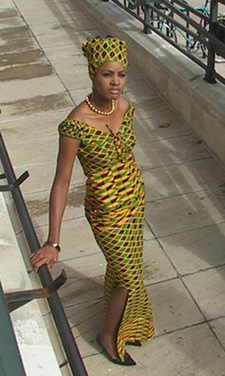
Wendy has made many traditional garments professionally and showed us examples, called kaba. A kaba is a three-piece outfit that made from about six yards of fabric. The skirt is usually a long straight skirt with a slit for walking ease. The top has a wide neck and a scoop back to show off shoulders. It can have any length of sleeves depending on the wearer’s preference. The third piece is a wrap. It can be tied around the hips, worn as a shawl, used as a head wrap, or left off entirely. Cotton is the main fabric, with some organza and satin trim used for accents. There was a lot of creativity in neckline embellishment and sleeve variation. For wearing to work, the skirt hem is shortened to knee length.
Wendy suggested going to www.aknfabrics.com if people are interested in purchasing traditional African fabrics.
Leigh Wheeler