
What's Out There: Sewing with Leather
At Spring Fling, Tricia Crocket taught a very informative class on leather. We learned a little about how leather is tanned and practiced sewing different types of seams in the process of making a small zippered bag. She touched on the different methods of tanning, and types of leather. It was really fun, so I thought I’d share a bit of what we learned and what I found out later doing some research.
Leather is tanned one of two ways, ‘chrome’ or ‘vegetable’ tanning. From shopping online for shoes, I’d seen some shoes described as vegetable tanned, but didn’t know what that meant. This just means that the skins are soaked in a water and tree bark solution. Water and the tannins from the bark cause the protein in the leather to be insoluble and resistant to decomposition. This can take weeks or months of soaking.
Historically, all leather was vegetable tanned. In the early days, Portland became well-known for leather production. Daniel Lownsdale built a very successful tannery in what is now the Pearl District back in 1845. He used bark from the trees cleared to create downtown Portland. Tanner’s Creek was named after his business.
The other way to tan hides is chemically. About 80-90% of leathers in the world are tanned by chrome tanning. Chrome tanning uses a solution of chemicals, acids and salts (including chromium sulphate) to tan the hide. Chrome tanning is very quick. It only takes about a day. The biggest drawback is that it is really bad for the environment if the chemicals are not disposed of properly.
We are lucky here in Portland to have three leather stores right here in town. This is great as not only do we save on shipping, we’re able to choose the skins ourselves and really check to make sure that the color matches well. When you go in to shop, take your pattern with you. Skins and hides are sold by the square foot, and the edges can be oddly shaped. You can best determine if you have purchased enough if you lay out your pattern pieces on the leather right in the store.
I discovered that the sewing was a lot easier than I had thought. With a walking foot and a jeans needle, I was set. One thing to note, even those of us who don’t like making muslins, really need to make one. Once leather is sewn, that’s it. Seams can’t be unpicked and re-sewn without damage to the leather. Since leather is a bit expensive, the fit needs to be right, and being familiar with the pattern is a huge plus.
Here are some good resources for working with leather:
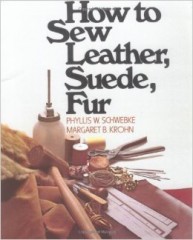
How to Sew Leather, Suede and Fur by Phyllis W. Schwebke
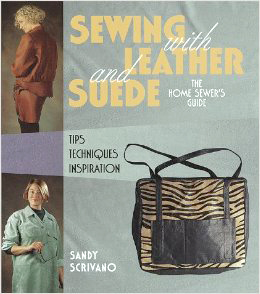
Sandy Scrivano’s book is good: Sewing With Leather and Suede: A Home Sewer’s Guide

Leather Fashion Design by Francesca Sterlacci is also a good resource
 Craftsy has some tips and a class on making leather bags.
Check out the Sew a Straight Line blog for a nice tutorial with a lot of pictures.
Local leather suppliers (who are very friendly and helpful):
Tandy Leather has two Portland locations. 13221 NE Whitaker Way is out by the airport, and 10195 SW Beaverton Hillsdale Hwy in Beaverton.
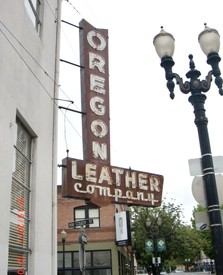
Oregon Leather is located at 110 NW 2nd Ave in Portland
Happy sewing everyone!
Leigh Wheeler
President
P.S. If you’d like more information about Portland’s history, check out Jewel Lansing’s book Portland: People, Politics, and Power – 1851-2001.

The Tandy Leather store in Beaverton is a few blocks west of Ernesto’s where the Fashion Lunch Bunch NG meets. It’s near the intersection of Western Avenue. I checked it out briefly after the June meeting. They have the same selection of supplies as the east location but not quite the quantity of each. I bought a bottle of the EcoWeld adhesive which is what we used in class, I think. I can’t wait to go back and browse the garment weight leathers!